


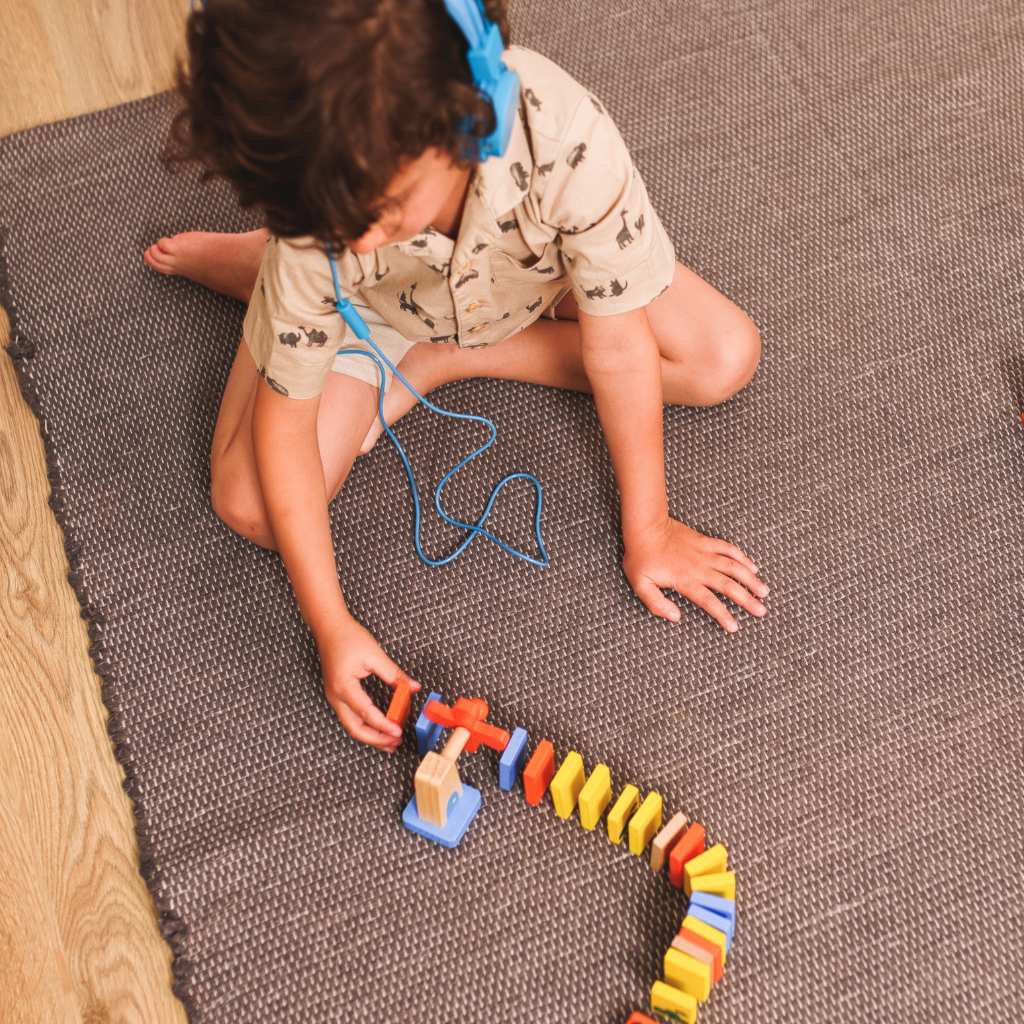
How Does Play Look in Autism?
Play is one of the clearest windows into early development.
Most toddlers gradually move through different stages of play:
- Exploring objects
- Using toys as intended
- Beginning simple pretend play
- Engaging others in play
For some children on the spectrum, play may look different, not delayed in effort, but different in focus.
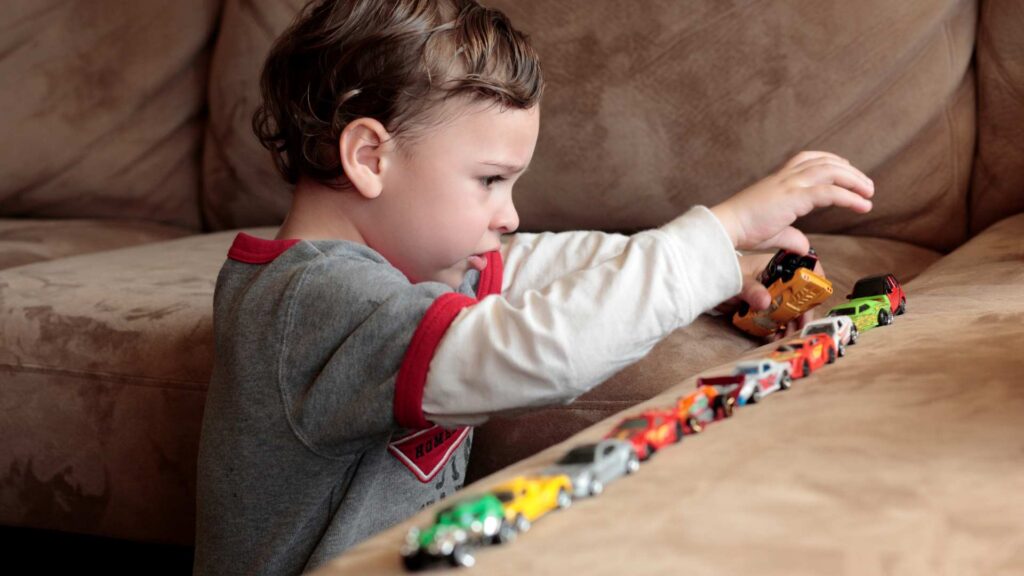
Instead of using toys for their intended purpose, a child may:
- Focus on arranging or organizing objects
- Repeat the same action over and over
- Pay attention to specific details (like order, spacing, or alignment)
- Show less interest in pretend or shared play
In simpler terms, it’s not that the child can’t play; it’s that they may engage with toys in a more structured, repetitive way.
When Should You Look a Little Deeper?
Many toddlers line up toys at some point. What matters is the overall pattern.
You may want to pay closer attention if:
- The behavior happens frequently and in the same exact way
- Your child becomes upset when the order is disrupted
- Play doesn’t expand into other types over time
- There is limited interest in interacting with others during play
- You’re noticing other early autism signs alongside it
This doesn’t automatically mean trastorno del espectro autista (ASD), but it does mean it’s worth understanding your child’s development more clearly.
Why Repetitive Play Can Feel So Important to a Child?
One of the most overlooked parts of this conversation is why a child continues this behavior.
Repetitive actions, like a toddler lining up toys, can serve a purpose:
- They reduce uncertainty
- They create a sense of control
- They help regulate emotions
- They provide predictable outcomes
For some children, especially those with sensibilidades sensoriales, predictable patterns can feel safer than open-ended play.
Understanding this shifts the perspective—from trying to stop the behavior to understanding what the child is getting from it.
Can This Behavior Change Over Time?
Yes—but not by forcing it to stop.
Children develop more flexible play skills when they are gradually exposed to new ways of interacting, supported at their level, and encouraged—not pressured—to expand their play.
With the right support, many children begin to:
- Use toys in different ways
- Engage in back-and-forth play
- Show more interest in shared activities
- Develop stronger communication skills
How Support Helps Expand Play and Communication

When repetitive play is part of a broader developmental pattern, early support can make a meaningful difference.
La terapia ABA is often used to help children:
- Expand how they play with toys
- Increase flexibility in activities
- Build communication through interaction
- Strengthen attention and engagement
Rather than focusing on stopping behaviors like lining up toys, therapy focuses on adding new skills—giving children more ways to explore, connect, and communicate.
Looking at This Behavior in a More Complete Way
So, is lining up toys a sign of autism?
It can be—but only when it appears alongside other developmental differences and remains consistent over time.
On its own, it’s simply a behavior. What matters is the context, the frequency, and how your child is developing overall.
If you’ve been asking yourself, why does my toddler line up toys, you’re already doing the most important thing—paying attention.
When It’s Time to Talk to Someone
If you’re noticing patterns that feel repetitive, limited, or different from other children your child’s age, you don’t have to figure it out on your own.
Getting a professional perspective can help you:
- Understand what’s typical and what’s not
- Identify early developmental differences
- Explore whether support could be helpful
- Feel more confident about your next steps
En ABA Centers of Florida, we support kids and teens on the spectrum through early intervention and personalized ABA therapy tailored to each child’s development.
If you’d like to talk through what you’re seeing—or simply get clarity on whether your child’s play patterns are typical—you can call (772) 773-1975 o schedule a free online consultation. A short conversation can often provide more reassurance (or direction) than weeks of uncertainty.






 English